

The Pinnapuram Integrated Renewable Energy Project (IREP) in Andhra Pradesh, India, stands as a testament to innovative engineering, combining solar, wind, and pumped storage hydropower to deliver reliable renewable energy. This ambitious project presents unique structural engineering challenges, particularly in integrating pumped storage reservoirs, turbine foundations, and solar/wind infrastructure.
Pumped Storage Reservoirs with Stable Embankments
Design and Stability
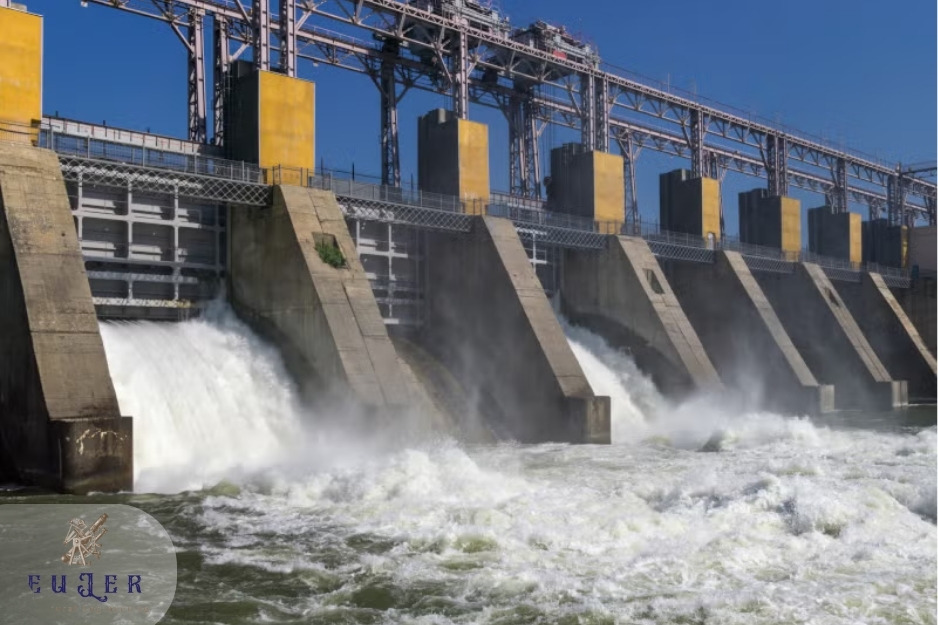
The project features two reservoirs—an upper reservoir at Pinnapuram and a lower reservoir linked to the existing Gorakallu reservoir—each with a capacity of 1.2 thousand million cubic feet (TMC). These are enclosed by 9.6 km-long rockfill dams with average embankment heights of 12-14 m (maximum 40 m for the upper and 33 m for the lower). Ensuring slope stability under full reservoir conditions is critical, especially given the off-river design, which lacks natural inflow and relies on one-time filling from Gorakallu. AFRY’s geotechnical analysis, including upper reservoir slope stability modeling, addresses risks like seepage and seismic activity.
Challenges
The high embankments require robust geotechnical solutions to prevent erosion or failure, particularly in Andhra Pradesh’s semi-arid terrain. Engineers use rockfill materials for cost-effectiveness but must ensure proper compaction and drainage to handle dynamic loads from water cycling (pumping and release). The 49 m-high upper dam across Muni Madugu adds complexity due to its 9.45 km² catchment area, necessitating advanced hydrological modeling.
Solutions
AFRY employed finite element analysis and 3D modeling to optimize embankment designs, ensuring stability under varying load conditions. Environmental measures, like catchment area treatment, mitigate siltation risks.
2. Turbine Foundations for Pumped Storage
Design Requirements
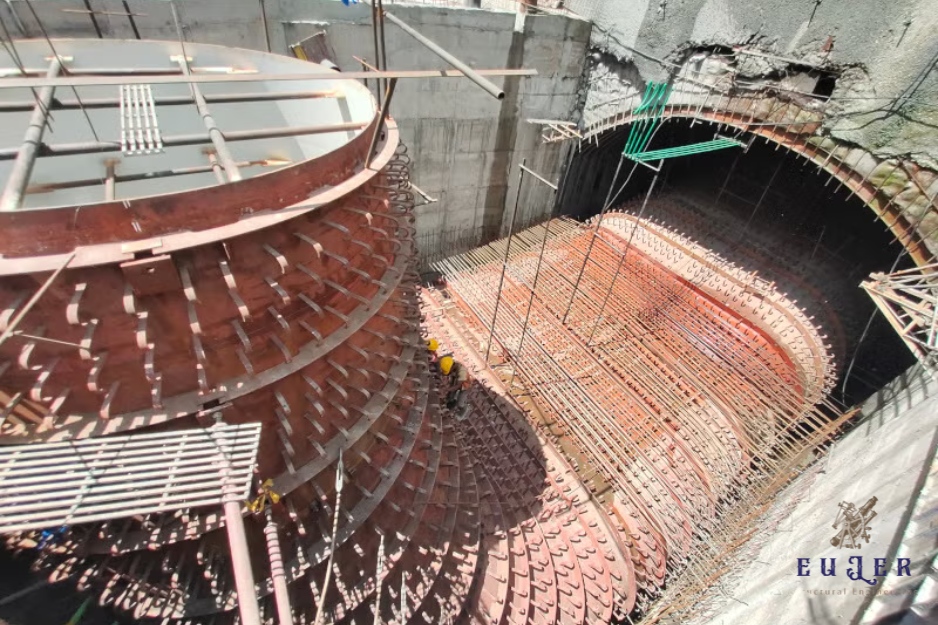
The subsurface powerhouse, measuring 240 m long, 24 m wide, and 58 m high, houses eight variable-speed, reversible Francis turbines (six 240 MW and two 120 MW units). These turbines, supplied by Andritz Hydro, operate in both generation and pumping modes, subjecting foundations to cyclic loading. The foundations must withstand vibrations and hydraulic pressures from a 119.27 m net head and 862.5 cubic meters per second discharge.
Challenges
The powerhouse’s location in a subsurface complex requires stable rock excavations in the Gani forest region, which poses geological risks like fault lines or weak strata. The five 760 m-long, 7 m-diameter penstocks, including one bifurcated penstock, transfer water at high pressure, necessitating reinforced foundations to prevent settlement or cracking.
Solutions
Engineers used high-strength concrete and rock anchoring to stabilize foundations, with real-time monitoring systems to detect stress or deformation. Andritz’s expertise in pump-turbine design ensures operational flexibility, reducing structural wear.
3. Integration with Solar and Wind Infrastructure
Hybrid System Design
The project’s 4,000 MW solar and 1,000 MW wind components are pooled with the 1,680 MW pumped storage via a central pooling station (CPS) connected to a 765/400 kV substation at Orvakallu. Solar arrays require lightweight, modular mounting systems adaptable to uneven terrain, while wind turbines need deep foundations to handle wind loads. The pumped storage system uses excess solar/wind energy to pump water, requiring synchronized structural and electrical designs.
Challenges
Coordinating these systems demands multidisciplinary expertise, as structural engineers must align with electrical and control system designers. For example, solar panel mounts must avoid shading from wind turbines, and turbine foundations must not interfere with reservoir embankments. The 20 km and 6 km transmission lines add complexity, requiring stable tower foundations across diverse terrains.
Solutions
An intelligent central control system optimizes energy flow, reducing structural stress by balancing loads. Modular designs for solar mounts and precast concrete for wind turbine bases enhance efficiency. Tata Consulting Engineers and Megha Engineering provided integrated design support, leveraging BIM (Building Information Modeling) for coordination.
4. Multidisciplinary Design Coordination
Complexity
The IREP’s scale and hybrid nature require collaboration among structural, geotechnical, hydraulic, electrical, and environmental engineers. The project integrates diverse components—reservoirs, powerhouse, solar arrays, wind turbines, and transmission lines—within a 714 ha site, including 380 ha of forest land.
Challenges
Misalignment between disciplines can lead to design conflicts, such as foundation overlaps or electrical grid instability. Environmental regulations, including rehabilitation and resettlement plans, add constraints to structural designs.
Solutions
AFRY’s detailed design engineering, awarded in March 2020, used collaborative platforms like Trimble’s Tekla Structural Designer to streamline workflows. Regular interdisciplinary reviews and digital twins ensured real-time updates across teams. Greenko’s partnerships with global firms like Andritz and Voith facilitated best practices in hybrid system design.
Conclusion
The Pinnapuram IREP exemplifies the integration of renewable energy sources through innovative structural engineering. By addressing challenges in reservoir stability, turbine foundation design, and hybrid infrastructure integration, the project sets a precedent for future renewable energy endeavors.
Euler Structures: Expanding Engineering Excellence
Euler Structures proudly extends its advanced structural engineering services across South Africa and neighbouring countries, driving innovation in renewable infrastructure.
Learn more about our structural engineering solutions.
Learn more about our full range of structural engineering services

Our Services
Structural Analysis
& Design

Structural Inspection
& Maintenance
Management (SIMM)
Structural
Audits
Structural Failure
Analysis & Investigation
Dynamic Vibration
Analysis & Design
Our Clients


Yellow Board 79 on R513,
Portion 20 Farm Schietfontein 437JQ,
De Wildt, 0251,
North West,
South Africa
Operating Hours
Monday to Fridays
07:00 - 18:00
Cell: +27(0)83 300 4787
Email: jlombard@eulerstructures.co.za


Proudly Designed and Built by Bunnypants | 2024
